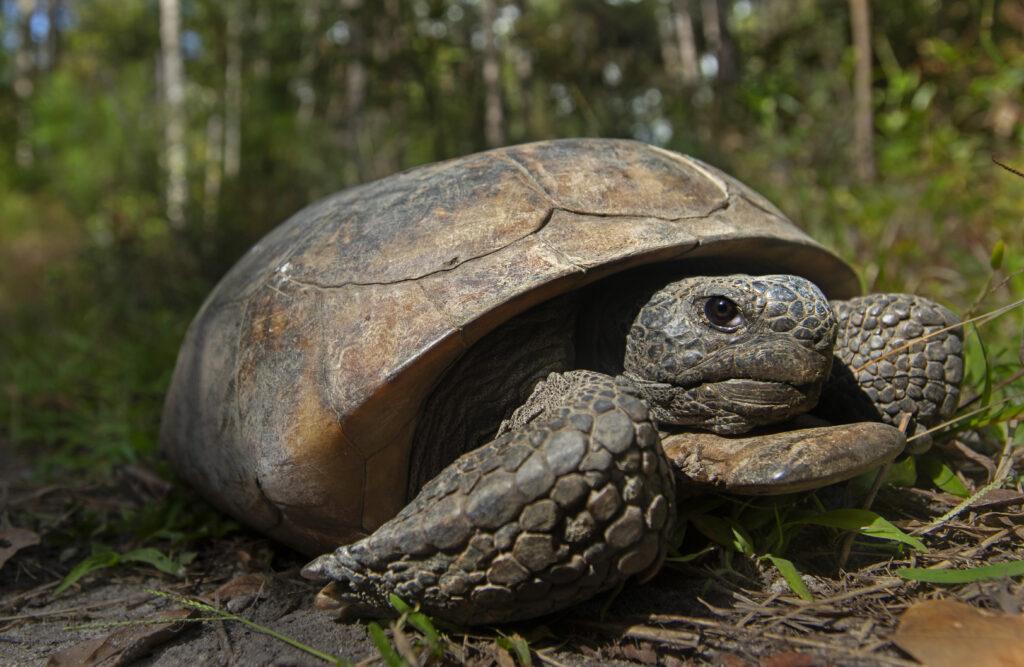
In the last issue, we talked about the management regime in our upland habitats that benefit our game species. This same management is also beneficial to many native reptile species, possibly the most important being the gopher tortoise (Gopherus polyphemus). While most people have probably heard of gopher tortoises, many don’t realize that they are the only tortoise species naturally found east of the Mississippi River. They thrive in the well drained sandy soils that are found all over SLP, and are considered a keystone species, digging burrows that are used by more than 360 other species!
One of the species that benefits from tortoise burrows is one that not many people have heard of, the Eastern coachwhip (Masticophis flagellum flagellum). This is a long and slender snake that can often be distinguished by its head and front part of its body sporting a dark brown or black color, with the back part of its body being a light tan color with scales resembling a braided whip. While their size can be intimidating, often reaching lengths of up to 7 feet, these are non-venomous snakes that pose no real threat to the people and dogs that might run into them in the pine flatwoods and scrub that they inhabit at SLP.
Venturing away from the upland species that have been discussed thus far, I would be remiss to talk about SLP’s native reptiles and not mention the American alligator (Alligator mississippiensis). They benefit greatly from the interconnected cypress swamps and other wetlands that are found throughout SLP and the surrounding areas. Alligators are truly living dinosaurs, having remained virtually morphologically unchanged in the last 8 million years, and commonly reaching lengths of up to 13 feet in this area!
These are just a few of the native species that can be found at SLP.
In a future issue, we will talk about some more of the animals that can be seen here and how they use and move about the landscape.
By Hunter Slade, CWB®, Senior Wildlife Biologist at Lykes Bros. Inc.