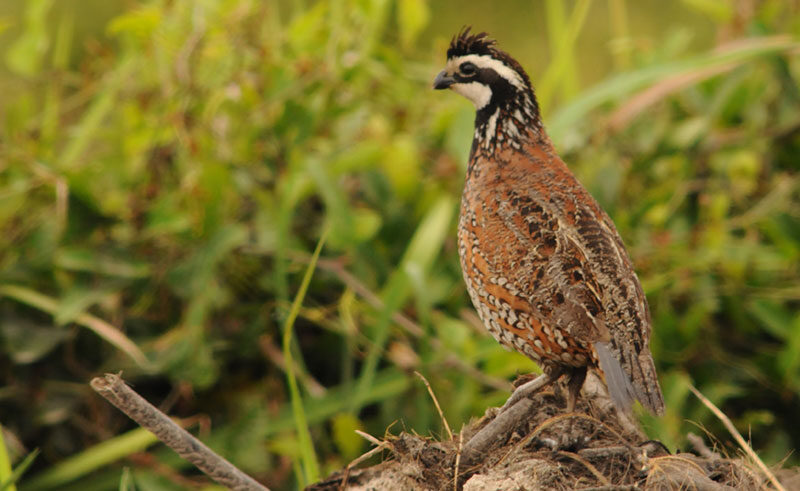
The focal point of the wildlife management that goes on at Silver Lake Preserve is for northern bobwhite quail (Colinus virginianus). This small game bird is native to the pine uplands of the southeastern coastal plain. They thrive in habitats that provide them with the “crazy quilt”, which consists of native bunch grasses for nesting, open areas with forbs and weeds for foraging, and dense brushy cover for escaping predators.
At SLP, we use a mix of frequent prescribed fire and mechanical treatment to achieve ideal habitat for these native birds. Luckily, this management regime also bodes well for other species native to the area.
White-tailed deer (Odocoileus virginianus) use the edge habitat created where well managed uplands meet brushy wetlands. Like quail, deer prefer a mixture of habitats where they can easily move through to feed and still have dense escape cover nearby to avoid predators. They like to venture out into recently burned areas to feed on fresh flowers, fruits and shoots emerging from the burned vegetation, as well as browse on the leaves of trees and shrubs in the area.
Osceola wild turkey (Meleagris gallopavo osceola), a subspecies of wild turkey that can only be found in peninsular Florida, also benefit greatly from the early successional habitat management occurring at SLP. Turkeys like to roost in the tall cypress trees found in the swamps and fly down early in the morning to the nearby open uplands to display and breed in the springtime. They also like to use freshly burned areas where they feed on seeds, fruits, insects and small vertebrates. Like quail, hen turkeys like to use native bunch grasses such as wiregrass and broomsedge for nesting cover.
These are just a few of the native species that can be found at SLP.
By Hunter Slade, CWB®, Senior Wildlife Biologist at Lykes Bros. Inc.