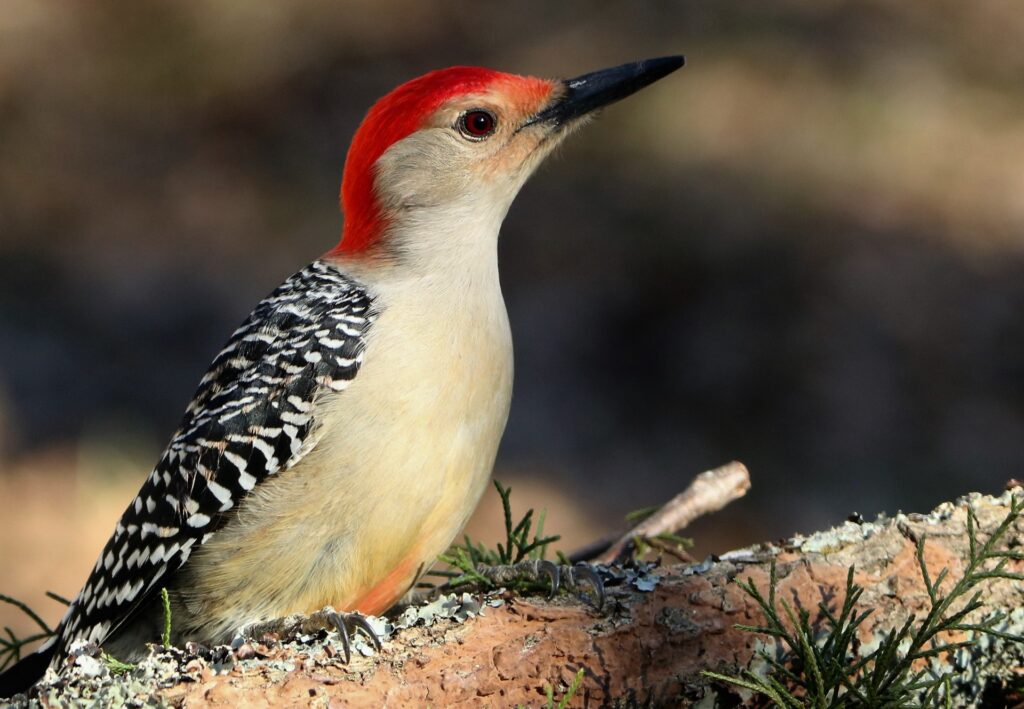
In this issue we will be highlighting some of the woodpeckers that can be seen at Silver Lake Preserve. One of the most common would be the red-bellied woodpecker (Melanerpes carolinus), which is what a lot of people would mistakenly call a red-headed woodpecker due to the obvious red found on the top of their head and running down the back of their neck. These birds are well adapted to human modified landscapes and are often seen hanging from trees near the lodge, but also greatly benefit from the open pine forests and edges created by all of the prescribed burning done at SLP. They can be seen using their strong beaks to make holes in trees in search of insects to feed on.
As previously mentioned, another bird found at SLP, although less common, is the red-headed woodpecker (Melanerpes erythrocephalus). Red-headed woodpeckers can be easily distinguished by its entire head and neck being a bold, red color. They are considered generalists when it comes to food, feeding on insects and fruits, but also taking advantage of other food sources that they come across such as eggs and nestlings from other bird species. They rely on cavities in dead trees for nesting, which are commonplace in the well managed upland pine forests at SLP.
The last species that I would like to highlight in this issue is the pileated woodpecker (Dryocopus pileatus). These large woodpeckers can be 7-9 inches bigger than their previously mentioned counterparts and can be distinguished by the bright red cone-like cap on the top of their head. They also use cavities in dead trees for nesting and like to hang out in the mature cypress and pines found throughout SLP. They feed mostly on insects, which they use their large beaks and long tongues to pull out of decaying trees. Pileated woodpecker populations were once in trouble due to deforestation, but thankfully they have made a dramatic comeback and are considered a species of least concern.
These are just a few of the native species that can be found at SLP.
In a future issue, we will talk about some more of the animals that can be seen here and how they use and move about the landscape.
By Hunter Slade, CWB®, Senior Wildlife Biologist at Lykes Bros. Inc.