In this issue we will be varying from the norm and talking about some of the non-native species that can be seen at Silver Lake Preserve.
We begin with the ring-necked pheasant (Phasianus colchicus). This time of year, these large birds can be found around SLP after being released during one of the pheasant tower shoots and often hang out in the brush of the quail fields. They can be quite the surprise for a lucky quail hunter when they flush nearly vertically with a loud cackle and fly away reaching speeds of nearly 40 miles per hour. Despite being one of North America’s most popular upland game birds, and even the South Dakota state bird, pheasant are not actually native to the continent. Instead, they were introduced to the U.S. from Asia in the 1880’s but now can be found in about 40 states. Pheasant are a rare case in which state agencies and NGOs alike specifically manage and conserve land for a non-native species; however, this management goes on to benefit all of the native species that use the same habitat.
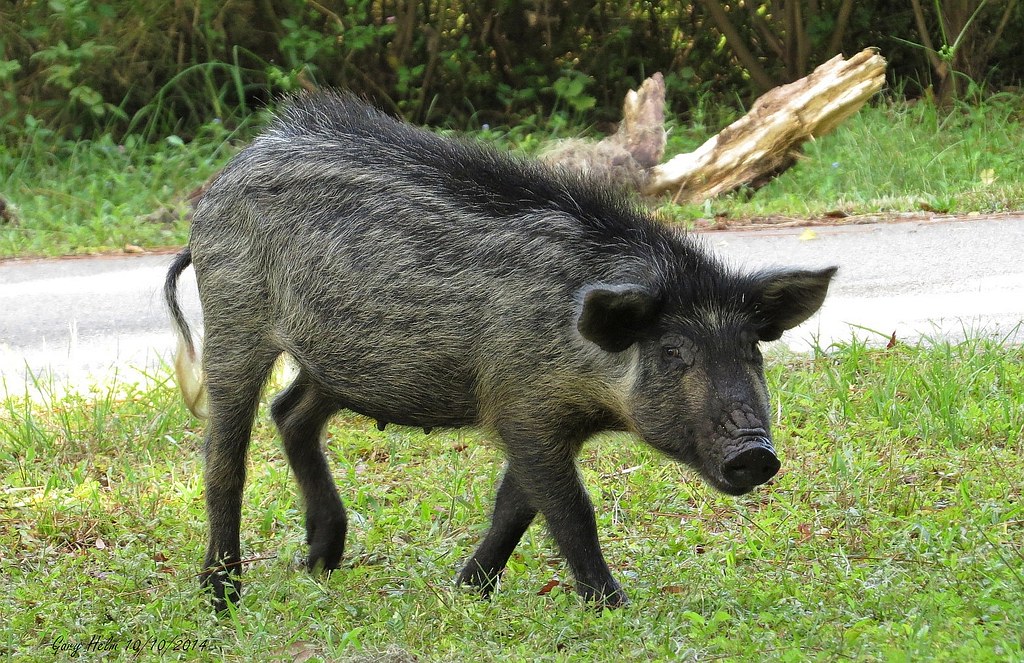
The next species is one that cannot go unmentioned when talking about non-native species in the U.S.: the wild or feral hog (Sus scrofa). Hogs were likely introduced to Florida by Spanish explorer Hernando DeSoto as early as 1539 and now exist in all 67 counties as well as at least 35 states across the U.S. While revered by many hunters, they are a major headache for farmers and land managers, causing billions of dollars in agricultural damage annually. Hogs are also detrimental to native wildlife as they destroy native habitats and make way for noxious invasive plants to take over. They are extremely adaptable and live in every habitat type at SLP, making them a constant battle to try to manage.
The last species I would like to highlight is one that might surprise most people as being non-native: the nine-banded armadillo (Dasypus novemcintus). Armadillos are native to southwestern North America but were actually introduced to Florida and the southeast as early as the 1920’s through accidental escapes from zoos and traveling circuses. They are considered “naturalized” rather than invasive because they likely inhabited Florida during the Ice Age before being temporarily extirpated. At SLP, armadillos can be seen milling around oak hammocks and upland habitats feeding on plants and insects. They dig burrows for their homes, and unlike gopher tortoises whose burrows will only have one entrance, armadillo burrows often have multiple. They always give birth to four offspring at a time, which will either be all male or all female. And the final fun fact on this animal is that when they need to cross narrow bodies of water they will simply sink and walk across the bottom underwater; however, if the water is wide enough, they will inflate their stomach to twice its normal size, allowing them enough buoyancy to swim.
These are just a few of the wildlife species that can be found at SLP.
In a future issue, we will talk about some more of the animals that can be seen here and how they use and move about the landscape.
By Hunter Slade, CWB®, Senior Wildlife Biologist at Lykes Bros. Inc.