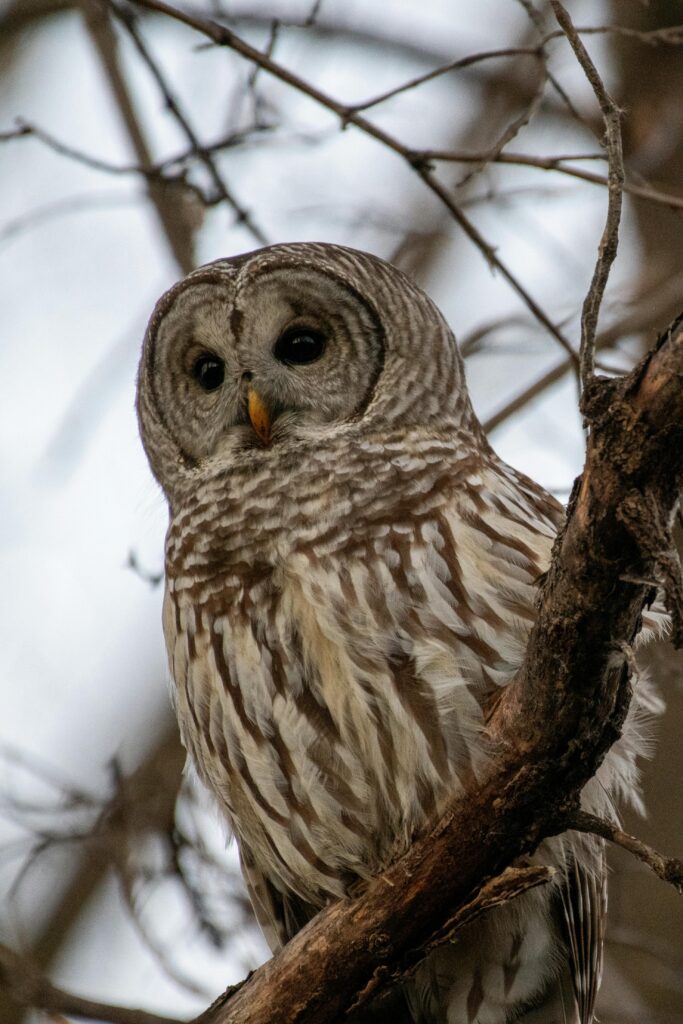
Spring is in the air at Silver Lake Preserve, and the turkeys are gobbling! Since the Osceola turkey was already discussed in a species spotlight last year, in this issue I am going to highlight some of the other birds in the woods that commonly make turkeys “shock gobble.” As many turkey hunters know, a shock gobble is when male turkeys impulsively sound off at loud noises around them. One of the most common noises to make a turkey shock gobble is the “Who cooks for you? Who cooks for you?” call of the barred owl (Strix varia). These relatively large owls have a wingspan of 40-50 inches, and are recognized by their feather patterns, which are barred with alternating color of white and brown. They are often found in mature forests with an open understory, the same habitat that turkeys like. They use this open understory to hunt small mammals, insects, and other birds. They are residents of Florida and do not migrate, in fact, their home ranges are often as small as 1 square mile. The life span of barred owls regularly exceeds 10 years and has been recorded as high as 26 years in the wild.
Another sound that will commonly induce a shock gobble is the loud, piercing call of the red-shouldered hawk (Buteo lineatus). These medium sized raptors have reddish/rust-colored shoulders, with barring across their chest and belly; however, in Florida they are more pale than in other parts of the country, having a gray head and lighter barring on the chest. They are year-round Florida residents and are the most commonly seen hawk throughout the state. They are often found in pine, oak, and cypress forests near water, but are commonly seen perched on fence posts in the open pastures where hunting is easier due to less cover for prey. The diet of red-shouldered hawks primarily consists of small mammals, lizards, snakes, and amphibians, but they will occasionally feed on other birds as well. Breeding pairs build nests in trees near open areas such as pastures. If the pair successfully raises young at a certain nest site, they will return to that same site year after year.
The final bird is one whose call almost every turkey hunter has imitated at some point while trying to locate a late morning gobbler: the American crow (Corvus brachyrhynchos). They share the preferred habitat of the previously mentioned species but will also seek out the human interface due to the availability of food in these areas. Crows will eat almost anything including, insects, earthworms, small mammals, seeds, fruit, garbage, and roadkill. They are known to be some of the smartest animals in the world, with their intelligence being on par with that of a chimpanzee. They have been observed using tools such as ripping a splinter of wood off a fence post to try to spear prey in a hole. They are known to follow adult birds to find where their nests are hidden in order to eat their eggs or chicks, and have been observed following and capturing songbirds as they arrive exhausted from long migrations. Crows and red-shouldered hawks are known to chase each other and try to steal food from one another, but they will also team up to mob and chase away larger predators such as great horned owls. Communities of crows can hold grudges for generations. Researchers at a university once captured American crows from nests while wearing caveman masks, and more than 10 years later, crows on campus still raised an alarm at the sight of a caveman mask.
These are just a few of the wildlife species that can be found at Silver Lake Preserve.
In a future issue, we will talk about some of the other animals that can be seen here and how they use and move about the landscape.
By Hunter Slade, CWB®, Senior Wildlife Biologist at Lykes Bros. Inc.