In this issue, we will be discussing some of Silver Lake Preserve’s native species that often fall into the “gross” category but are all quite interesting once you take a deeper look.
We are going to start with Florida’s only native marsupial, the Virginia opossum (Didelphis virginiana). Like their distant cousin, the kangaroo, opossums give birth to underdeveloped offspring, which are about the size of a bee, but continue to grow in a pouch on the mother for about 80 days. Dozens of offspring are born at one time, but only those that secure one of the 13 teats inside the pouch survive. One of the most known traits of an opossum is their ability to “play dead.” This is not a conscious act, but rather an involuntary response to extreme fear. During this state, known as thanatosis, the animal’s eyes glaze over, their tongue hangs, and they emit a foul scent of death from their anal glands that often discourages potential predators.
Opossums are omnivores and scavengers that feed on almost anything from plants to animals to garbage and even roadkill. They are known to feed on venomous snakes such as rattlesnakes and cottonmouths and even have a partial resistance to the venom from the bites of these snakes. There are claims that they also consume thousands of ticks; however, this seems to have come from a laboratory setting with other studies showing that ticks likely do not make up much of their diet and instead are only consumed occasionally while grooming. While this diverse diet allows them to thrive in almost any environment, it also tends to get them labeled as pests when they overlap with human landscapes. The reality is that opossums pose almost no risk to humans as they are shy, not aggressive and rarely carry rabies, unlike what rumors may suggest.
Next, we are going to discuss two species that are rarely seen but often smelled around SLP: the striped skunk (Mephitis mephitis) and the eastern spotted skunk (Spilogale putorius). The striped skunk is what most people think of when they think of skunks. They are your typical black with white stripes and a long fluffy tail. They are the larger of the two species with a total length of about 31 inches. Spotted skunks are notably smaller at about 21 inches in length and mainly black with a series of broken-up white stripes all over their body that resemble spots. Both species are found throughout Florida, except for the Keys, and inhabit natural ecosystems with a mixture of dense vegetation with close by open areas. Both make their dens in a variety of locations from digging their own burrows or using vacant gopher tortoise burrows, to brush piles or wood piles. Striped skunks often have litters of 6 to 8 young, while spotted skunks will give birth to 5-6. These young skunks, called kits, will stay at the den site for 6-8 weeks before leaving to learn to forage with their mother for several months.
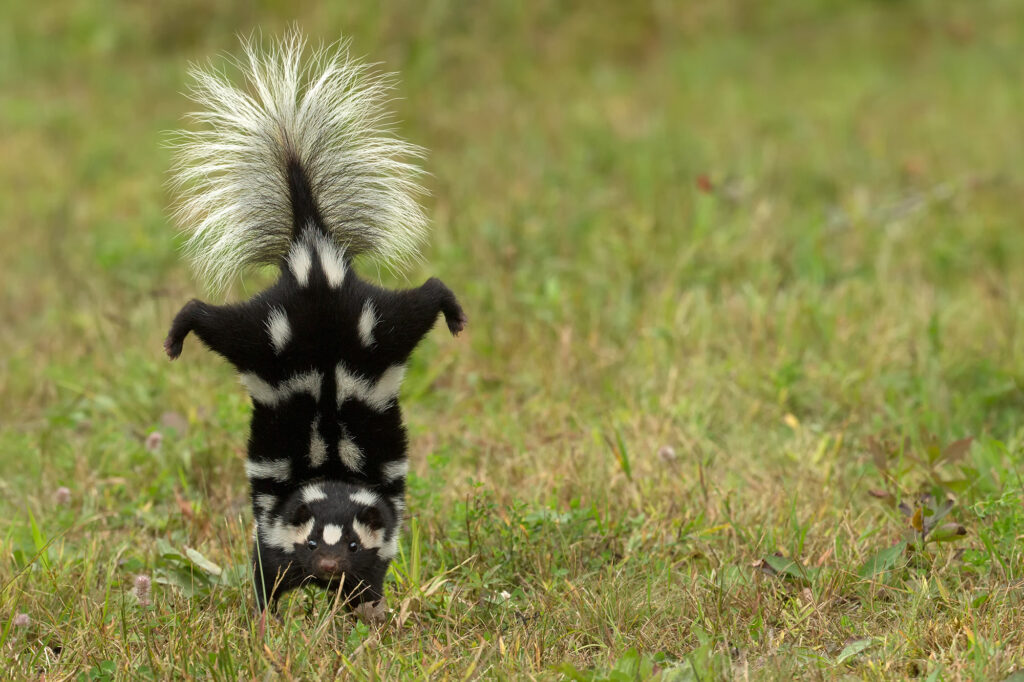
Both are mostly nocturnal, only coming out of their dens at night to forage, but some evidence suggests that spotted skunks are also active during the day. Skunks are omnivores and feed on a large variety of plants and animals based on what is available that time of year including small mammals, birds, amphibians, reptiles, crustaceans, insects, fruits, grasses, fungus, and leaves. Since both species are relatively small, their main predators are great horned owls, bobcats, and coyotes. The main response to predators is to try to run away, but both will act aggressively and make themselves look larger if retreat is not an option. Striped skunks will arch their backs and stomp their feet towards the predator, while spotted skunks will stand on their front two feet with their back legs and tail in the air. As a last resort, both will exhibit the familiar defense mechanism of spraying a pungent oily musk from their scent glands, which can be aimed at targets as far as 15 feet away.
These are just a couple of the wildlife species that can be found at Silver Lake Preserve.
In a future issue, we will talk about some of the other animals that can be seen here and how they use and move about the landscape.
By Hunter Slade, CWB®, Senior Wildlife Biologist at Lykes Bros. Inc.